
Strategic thinking is the hallmark of leadership, the cornerstone of executive excellence, and a driving force behind long-term organizational success. It is the ability to rise above immediate demands, understand the bigger picture, anticipate change, and make choices that move an organization toward a desired future. For senior executives, strategic thinking is not a casual planning exercise. It is a disciplined way of observing, questioning, deciding, leading and acting.
This capability develops through consistent practice. Over time, leaders learn to recognize patterns, test assumptions, connect the dots, and distinguish a passing disruption from a foundational shift.
Strategic thinking matters because it helps executives make better choices, decide where to focus, what to stop doing, which capabilities to build, and how to align their people behind a clear strategic direction.
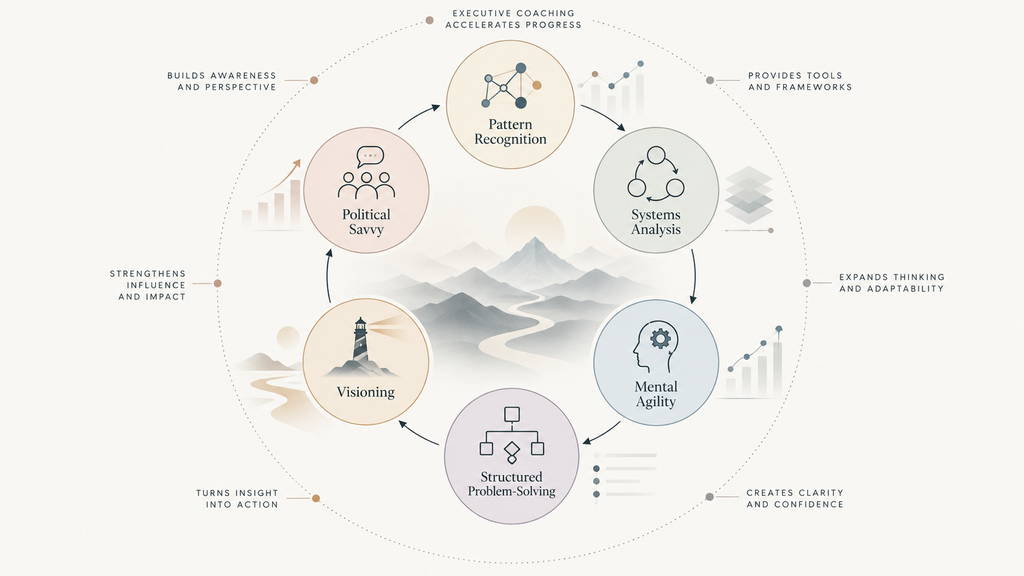
Executive coaching accelerates this development by creating a structured, confidential space for leaders to examine their own thinking, test assumptions with a trusted outside perspective, and build the disciplines below with greater speed and intention than practice alone typically allows.
What Defines Strategic Thinking?
Strategic thinking thrives on collaboration, intellectual curiosity, and a willingness to challenge the status quo. It means looking beyond familiar explanations, asking better questions, and studying both the internal organization and the external environment. It requires leaders to balance agility with decisiveness: remaining open to new evidence while committing resources and taking calculated risks when action is needed.
Strategic leaders synthesize financial indicators, customer insights, operational measures, workforce capabilities, competitive advantages, and emerging trends into a clear point of view to establish priorities and make trade-offs.
Thriving in a VUCA World
We live in a VUCA world - defined by volatility, uncertainty, complexity, and ambiguity. Economic shifts, geopolitical events, changing customer expectations, workforce disruption, and new technologies such as generative AI can quickly alter the assumptions behind a strategy. In this environment, strategic thinking is indispensable for resilience and growth.
Executives must assess internal dynamics, including financial health, operational performance, organizational culture, talent, and change readiness. At the same time, they must scan the wider ecosystem for regulatory, social, political, competitive, and technological advancements. The goal is not to predict the future with certainty but to identify plausible scenarios, recognize early trends, and prepare the organization to change and transform.
The Six Disciplines of Strategic Thinking
In Michael Watkins’ book The Six Disciplines of Strategic Thinking, a framework is presented that offers a practical method to strengthen this leadership capability.
1. Pattern Recognition
Executives adept at strategic thinking notice meaningful similarities and emerging trends. They compare current developments with prior experience. Pattern recognition helps executives identify opportunities, threats and potential risk early on, but it must be balanced with curiosity and deep thinking so that a familiar pattern does not become misleading.
A coaching partnership helps leaders examine which of their recognized patterns are genuinely predictive - and which are assumptions masquerading as experience.
2. Systems Analysis
Organizations operate as interconnected systems rather than isolated functions. A pricing decision may influence customer demand, operations, employee workload, cash flow, and brand reputation. Systems analysis helps leaders trace these relationships, anticipate unintended consequences, and understand where a carefully chosen intervention can produce broader results.
Coaching builds this discipline by helping leaders map the ripple effects of their decisions before they are made, not after.
3. Mental Agility
Executives need the ability to shift between the big picture and operational detail, short-term realities and long-term possibilities, and competing stakeholder perspectives. Mental agility allows a leader to update a position when new evidence emerges without losing strategic direction. It also supports constructive debate and reduces the risk of becoming trapped by one interpretation.
Coaching develops mental agility by regularly exposing leaders to alternative framings of their own situations - building the mental flexibility to hold multiple perspectives simultaneously.
4. Structured Problem-Solving
Complex challenges become more manageable when leaders define the problem clearly, separate symptoms from causes, develop hypotheses, gather relevant evidence, and evaluate alternatives. This structured approach prevents teams from rushing toward a preferred solution before fully understanding the issue. It also creates a transparent decision-making process that others can examine, challenge, and support.
A coach functions as a thinking partner who slows the problem-solving process down at the right moments - helping leaders distinguish the real problem from the presenting one.
5. Visioning
Strategic leaders create a compelling picture of what the organization can become. Effective visioning is ambitious but grounded in reality. It clarifies why change matters, what success looks like, and which capabilities must be built. A strong vision gives people direction and meaning while leaving enough room for adaptation as conditions evolve.
Coaching helps leaders articulate and stress-test their vision - separating a genuinely compelling future from one that sounds strong in a boardroom but doesn’t move people.
6. Political Savvy
Even a sound strategy will stall without support. Political savvy is the ability to understand stakeholder interests, sources of influence, informal networks, and potential resistance. It enables executives to build coalitions, communicate with different audiences, resolve conflict, and mobilize people around shared outcomes. This is not manipulation; it is the groundwork of creating clarity and alignment for meaningful change.
Political savvy is one of the most consistently underestimated disciplines - coaching helps leaders develop it by building self-awareness around their own influence style and its impact on others.
Essential Skills for Strategic Leadership
Watkins’ disciplines reinforce several essential executive skills. Scenario planning helps leaders imagine plausible futures and identify specific necessary actions. Analytical capability turns data into insight, while emotional intelligence builds trust and psychological safety. Critical thinking exposes weak assumptions, and creative thinking generates alternatives.
These capabilities are strongest when practiced collectively. Perspectives from stakeholders, including customers, employees, partners, and peers reduce blind spots. Leaders can build strategic capacity through reflection, scenario exercises, assumption reviews, and discussions of external trends.
From Strategic Thinking to Strategy Execution
Strategic thinking formulates direction, but strategy execution moves the organization into the future. Execution begins by translating the vision into clear priorities. Each priority should have a defined outcome, accountable executive owner, measures of progress, required resources, and key milestones.
Alignment is critical. Business units, functions, teams, budgets, incentives, and talent decisions must reinforce the same strategic priorities. Leaders should communicate the strategy repeatedly in plain language, connecting enterprise goals to the daily decisions employees make. People are more likely to act when they understand not only what is changing, but why it matters and how their work contributes to the desired outcome.
Execution also requires a disciplined operating rhythm. Leaders should review leading indicators as well as financial results, address barriers quickly, and test whether strategic assumptions remain valid. Short feedback cycles allow the organization to learn and adapt while executing.
A Vision for the Future
Strategic leadership integrates insight, decisions, alignment, and action. Leveraging Watkins’ six disciplines as a framework, executives can recognize what is changing, understand complex systems, solve the right problems, envision a stronger future, and mobilize their teams. When those disciplines are supported by clear priorities, aligned resources, accountable ownership, and continuous learning, strategy becomes more than an aspiration. It becomes a practical pathway for moving the organization forward with clarity, resilience, and purpose.
Reflection Questions
What patterns are you currently relying on that might be assumptions rather than evidence?
Which of the six disciplines feels least developed in your own leadership right now, and what would it take to strengthen it?
Where in your organization is strategic thinking most needed and least present?
FAQs
What is strategic thinking in leadership?
Strategic thinking in leadership is the disciplined ability to see past immediate demands, recognize meaningful patterns, understand complex systems, and make deliberate choices about where an organization is headed. Where operational thinking manages what exists today, strategic thinking is concerned with what the organization needs to become.
What are the six disciplines of strategic thinking?
Michael Watkins' framework names six disciplines: pattern recognition, systems analysis, mental agility, structured problem-solving, visioning, and political savvy.
Pattern recognition: Noticing meaningful trends and similarities early, while staying curious enough that a familiar pattern does not mislead.
Systems analysis: Tracing how a decision in one part of the organization moves demand, operations, workload, cash flow and reputation elsewhere.
Mental agility: Moving between the big picture and operational detail, and updating a position on new evidence without losing strategic direction.
Structured problem-solving: Defining the problem clearly, separating symptoms from causes, and testing alternatives against evidence before committing.
Visioning: Building a picture of what the organization can become that is ambitious but grounded, and clear about which capabilities must be built.
Political savvy: Reading stakeholder interests, sources of influence and informal networks well enough to build coalitions and mobilize people.
Can strategic thinking be developed, or is it innate?
It can be developed. Watkins’ six disciplines (pattern recognition, systems analysis, mental agility, structured problem-solving, visioning, and political savvy) are each learnable through consistent practice, reflection, and structured development.
What is the difference between strategic thinking and strategic planning?
Strategic thinking is the cognitive discipline that generates insight, identifies possibilities, and frames direction. Strategic planning is the operational process of translating that direction into priorities, timelines, resources, and accountability. Both are necessary, but planning without thinking produces activity without insight, and thinking without planning produces vision without traction.
How does executive coaching support strategic thinking development?
Coaching creates a structured space for leaders to examine their own thinking patterns, test assumptions, and build the mental disciplines that strategic thinking requires, particularly the ones that are hardest to develop alone, like recognizing blind spots, challenging long-held beliefs, and developing political savvy. The outside perspective of a skilled coach accelerates what experience alone takes much longer to build.
What is the VUCA framework and why does it matter for executives?
VUCA stands for Volatile, Uncertain, Complex, and Ambiguous - originally coined by the U.S. Army and now widely applied to the business environment. For executives, it describes the conditions under which strategic thinking is most necessary and most difficult: when the environment is shifting faster than assumptions can keep up, and when no single perspective is sufficient to navigate it well.
Develop Your Strategic Leadership Capability
Strategic thinking is not a fixed trait. It is a set of disciplines that deepen with the right kind of practice and the right thinking partner.
Laura Aziz, PhD, PCC is an executive and leadership coach based in Chicago, working with C-suite leaders, senior executives, and high-potential leaders across industries. Her coaching approach is relationship-centered and strengths-based, helping leaders build the strategic clarity, relational awareness, and organizational influence needed to lead effectively in complex environments.
Work with a Bridgeline executive coach to strengthen your strategic thinking and leadership impact. Schedule a Conversation to learn more about working with Laura, or to explore Bridgeline Executive Coaching & Leadership Development more broadly.