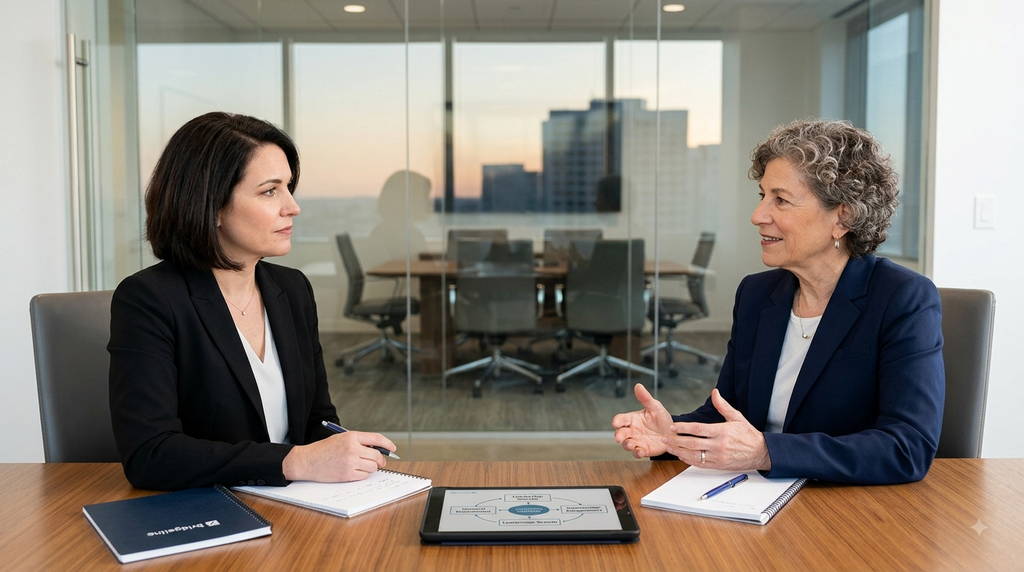
One of my executive coaching clients, a Senior VP of Operations I’ll call Laura, strode confidently into a senior leadership team meeting certain that her rollout plan for a new company initiative would go like clockwork. Instead, most of the team was not on board. In fact, several said the plan had fatal flaws and that they wished she had brought it to them much earlier for their input. Laura was deeply disappointed not to get the engagement she had expected.
It’s a scenario more leaders face than most will admit, and it’s where the benefits of executive coaching become most visible. You’ve done the work. You’ve built the plan. You’ve thought through every detail, and the room still doesn’t follow you. The plan itself is rarely the problem. The people who needed to own it were never part of building it.
When the Plan Is Sound but the Room Isn’t With You
We live in a “VUCA” world: volatile, uncertain, complex, and ambiguous. The term was coined by the US Army decades ago, and it describes the present far better than the era that produced it. What happened to Laura was a textbook VUCA moment. The initiative itself was solid, but the environment she was operating in with competing priorities, unspoken concerns, and shifting team dynamics was more complex than any plan could account for on its own. The fatal flaw wasn’t in her strategy. It was in assuming that a strong plan would speak for itself without first building the relational groundwork for people to receive it.
This is one of the most common patterns I see across the leaders I work with. The higher you rise, the more your success depends not just on the quality of your thinking, but on your ability to bring others into that thinking to help craft the plan, before you present it as finished. The instinct in these moments is to work harder on the plan. The real leverage is in how you listen to, and therefore engage, the people around it.
What to Expect from Executive Coaching: Inside The Next Session
At our next coaching session, Laura had several realizations that helped her regain perspective. She was even able to see the humor in the situation.
What did that session actually look like? It started with a question I often ask clients who’ve just experienced a setback they didn’t see coming: “What did you assume everyone was on board with before you walked into that room?”
Laura paused. She realized she had assumed an alignment that didn’t exist. She had built the rollout in relative isolation, not out of arrogance, but out of a genuine belief that thorough preparation was the same thing as leadership. That distinction, between doing the work for your team and doing the work with your team, became the central insight of our coaching engagement.
From there we explored her strengths. Laura was an exceptional strategic thinker with a deep operational mind. Those were never the problem. What she hadn’t fully leveraged was her ability to listen, to invite dissent early, and to treat her team’s pushback as objective data rather than as resistance or anything personal. Once she made that reframe, her entire approach shifted.
The Loneliness of Leadership
Executive coaching provides a confidential space to think through where you’ve been, where you are, where you’re going, and the strategies to get there. The loneliness of leadership is real, and it deepens as you ascend. Many leaders in Laura’s position have no one to talk to at work because of their role, and they don’t want to lean on the people at home for a deep conversation about work. It can be lonely as one ascends in leadership.
This is something that rarely gets acknowledged openly: the more senior you become, the fewer honest conversations you have. Direct reports filter what they tell you. Peers are navigating their own politics. Board members see a version of you, not the full picture. A coaching partnership fills that gap, not with advice, but with the kind of rigorous, confidential thinking partnership that helps a leader see what they can’t see from inside their own position.
Laura discovered that an executive coach could become a genuine partner in her growth.

From Setback to Stakeholder Engagement
The positive impacts of coaching don’t come from a formula. Experienced executive coaches use powerful questions, well-researched assessments, active listening, feedback, and customized strategies to help clients clarify and achieve their goals.
For Laura, the work became very concrete very quickly. She went back to her team, not with a revised plan, but with questions. She asked each senior leader what their concerns were, what they would need to see in order to support the initiative, and what she had missed by not involving them earlier. Several of them told her it was the first time an SVP had asked for their input before a decision was already made.
Initially, a leader and a well-thought-out plan walked into a room and everyone else in that room was meeting the plan for the first time. The shift from presenting to engaging didn’t just save the initiative. It fundamentally changed how Laura operated as a leader.
What Changed Over the Course of the Engagement
Over the course of the coaching contract, Laura increased both her self-awareness and her influence. She learned about her own strengths and about her team members’ strengths, applied change management strategies, delegated more effectively and catalyzed greater engagement from the team. The changes did not happen overnight, but after several months the entire team was aligned and the revised project launched successfully.
What’s worth noting is what Laura didn’t do. She didn’t become a different leader. She became a more complete version of the leader she already was. The strategic mind was always there. Coaching helped her pair it with the relational awareness and stakeholder engagement skills that turn solo performance into a team effort. This new way of applying her strengths generated a win all around; what I call a 360Win™.
The Benefits of Executive Coaching, Seen Through One Engagement
Laura’s arc is specific to her, but the mechanisms behind it show up in most engagements. The executive coaching benefits that senior leaders describe most often are these:
Blind spots become visible. Laura’s gap wasn’t skill or effort. It was an assumption she couldn’t see from inside her own position, which is precisely the category of problem a coach is useful for.
Assumptions get tested before they cost you. A single question in a coaching session surfaced what a failed meeting had already cost her.
Pushback becomes usable information. Reframing her team’s resistance as data rather than opposition changed both the plan and the relationship.
Existing strengths get re-focussed, not replaced. Laura’s strategic mind was never in question. Coaching paired it with relational awareness she already had but hadn’t leaned on. This was a winning combination.
Isolation at the top gets a counterweight. The higher the role, the fewer honest conversations. A coaching partnership restores at least one regular honest, open conversation.
Reflection Questions
What assumptions might you be carrying into your next important meeting that you haven’t tested with the people in the room?
When was the last time you invited honest pushback before presenting a finished plan?
If you’re finding that leadership feels increasingly isolated, what would it look like to have a thinking partner whose only agenda is your growth?
FAQs
What are the benefits of executive coaching for senior leaders?
Executive coaching gives senior leaders a confidential space to examine blind spots, test assumptions, and develop the relational and strategic skills that are harder to build through training alone. The benefits are often clearest in exactly the kind of high-stakes, ambiguous situations where leaders most need an outside perspective — and have the fewest people to turn to.
What’s the difference between executive coaching and leadership coaching?
The terms are often used interchangeably, and the benefits of leadership coaching and executive coaching overlap almost entirely. Both build self-awareness, sharpen decision-making, and strengthen influence. In practice, “executive coaching” tends to describe work with senior leaders carrying organizational scope, like Laura, while “leadership coaching” gets used more broadly across levels. What matters more than the label is whether your coach has worked with leaders facing your scale of complexity.
How is executive coaching different from consulting or mentoring?
Consultants bring answers. Mentors share their own experience. A coach does neither. Instead, they use questions, assessments, and structured reflection to help you find your own answers, which is why the results tend to be more durable: because they come from your own thinking rather than someone else’s.
Can coaching help if my team isn’t aligned on a major initiative?
Yes, and it’s one of the most common reasons leaders engage a coach. Misalignment is rarely about the plan itself. It’s about how the plan was built and communicated. Coaching helps you identify and close those gaps before they become visible problems.
How long does an executive coaching engagement typically last?
Most engagements run between three and twelve months, depending on the scope and goals. Meaningful shifts in leadership approach, like the ones Laura experienced, tend to become visible within the first few months, though deeper behavioral change takes longer to consolidate.
What should I look for in an executive coach?
Look for ICF credentialing (PCC or MCC), direct experience working with leaders at your level, a structured approach that includes assessments and accountability, and, most importantly, someone you trust enough to be honest with. The relationship is the tool.
Lead With Greater Clarity and Impact
If Laura’s story resonates, you’re not alone, and you don’t have to navigate it without support. Every Bridgeline engagement starts with a conversation about what you’re actually facing, and we match you with the coach suited to it. Schedule a consultation to get started, or explore Bridgeline's executive coaching services.
Patricia Rachel Schwartz is a Master Certified Coach (MCC) with close to 40 years of experience in leadership development, having worked with over 350 C-suite and VP-level leaders across six continents. Her strengths-based approach helps leaders uncover what’s already working and build on it, turning real workplace challenges into measurable growth. To learn more about working with Patricia or explore Bridgeline’s Executive Coaching & Leadership Development more broadly, schedule a conversation now.