
For high-performing leaders, the hardest word in the English language is often the shortest one. Learning how to say no at work is not about becoming difficult, unavailable, or less committed. It is about protecting your priorities, communicating clearly, and making sure your yes still means something. Here’s how to use it without damaging relationships or stalling your career.
The Cost of Yes
A few years ago, a Bridgeline coach worked with the IT Director at a major retailer. He was frustrated with his counterpart in Operations. The two had been collaborating on an innovation project that both agreed would genuinely improve the business, until Operations kept deprioritizing it in favor of other requests.
When the coach asked the IT Director why he was surprised, the answer was telling: “She says yes to everyone. She’s a people pleaser.”
Here’s what that framing misses. The Operations leader wasn’t saying yes to everyone out of weakness or a need to be liked. She was saying yes because every request that came to her door seemed reasonable in isolation. The project kept slipping not because of poor character, but because she had never developed the discipline of saying no at work.
If you’re a leader, you already know the pull. The inbox fills. The calendar packs. Colleagues make requests that feel legitimate because many of them are. And every time you say yes to one thing, you are quietly saying no to something else. You’re just not deciding which something else. You’re letting it be decided for you.
Learning how to say no at work is not about becoming less helpful. It is about protecting the work that only you can do.
Why Leaders Find It Harder Than Anyone
The usual explanations, wanting approval and avoiding conflict, are true but incomplete. Leaders also operate in high-interdependency environments. A no to a peer can slow their team. A no to a direct report can feel like abandonment. A no to a senior stakeholder can feel like career risk.
So instead of learning how to say no professionally, most leaders learn sophisticated forms of delayed yes: “Let me look into that,” “I’ll try to get to it,” or “Put it on the list.”
Delayed yes is not kinder. It leaves people waiting, guessing, and ultimately more disappointed when the answer turns out to be no after all. A clean, early no respects the other person’s time and yours.
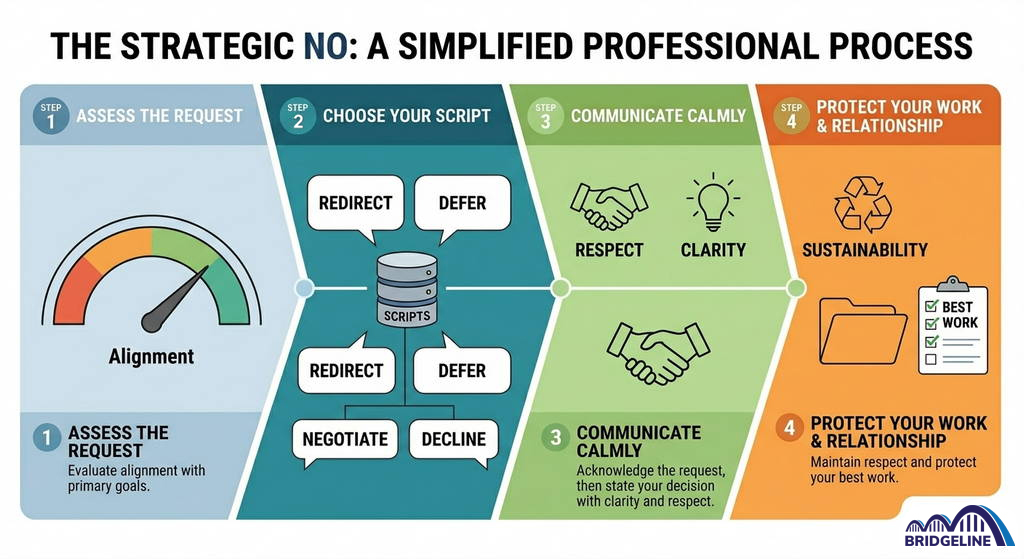
This is also where assertive communication and the ability to communicate to connect, not to impress, become leadership skills rather than just communication styles. The goal is not to be harsh. The goal is to be clear enough that people know where they stand.
Nine Ways to Actually Say No at Work
The following are real-world scripts you can use immediately. None of them require an apology or an elaborate justification. They are firm, professional, and designed to preserve the relationship.
- The honest redirect:
“I’m not going to be able to take this on. I want to be straight with you rather than keep it in a queue where it won’t get the attention it deserves. Have you tried [colleague or team]?” - The priority anchor:
“Right now I’m heads-down on [specific project], which is my top priority through [timeframe]. I can’t give this the attention it would need. Can we revisit in [month]?” - The trade-off offer:
“I can take this on, but it would mean pulling back from [current commitment]. Is that a trade-off you’d want to make? I want to be sure you have the full picture.” - The boundary with warmth:
“This sounds like an important initiative. My honest answer is that I’m not the right person for it right now. I’d rather tell you that now than let you down later.” - The resource redirect:
“I’d love to help, but my bandwidth is genuinely tapped. Is there a way to get [resource, tool, or team] involved? That might actually serve you better.” - The partial yes:
“I can’t commit to the whole thing, but I could [specific limited contribution] if that would still be useful.” - The values check:
“I’ve thought about this, and I don’t think I’m the right fit, either in terms of capacity or expertise. I don’t want to take something on and do it at 60%. You deserve better than that.” - The scheduled conversation:
“Can we find 15 minutes to talk about this? I want to give you a real answer, not a quick one, and I need to look at what’s already committed before I can say yes or no.” - The direct no:
“No, and I want to be useful, so let me explain why. [Brief, honest reason.] I hope that’s clearer than a delayed maybe.”
What to Do When Someone Pushes Back
The pushback usually comes in two forms. The first is emotional: “I can’t believe you won’t help with this.” The best response to an emotional push is not a longer explanation. It is a calm restatement. This can be especially important when you are navigating dominant personalities at work, where overexplaining can sometimes invite more pressure rather than create more clarity.
“I understand this is frustrating. My answer is the same.”
The second is logical: “But you said you’d have capacity in Q2.” This deserves a real answer. Acknowledge the discrepancy, explain what changed, and if appropriate, offer an alternative.
“You’re right that I said that. Since then, [X] changed, which affected my bandwidth. I should have told you sooner. Here’s what I can actually offer.”
The goal in both cases is not to win the argument. It is to end the interaction with the relationship intact and your capacity protected. Saying no at work professionally means staying grounded without being cold.
For many leaders, this is part of the broader work of developing emotional intelligence and learning how to communicate with both honesty and restraint.
FAQs
How do you say no at work without damaging the relationship?
Say no early, say it clearly, and give a brief reason that is honest rather than elaborate. Most relationships are damaged not by the no itself but by the delayed no, where someone waited for a yes that never came. A prompt, respectful no at work gives the other person time to find another solution and signals that you respect their time.
Is it unprofessional to say no to your boss?
Not if you say it the right way. Saying no to your boss professionally means offering context: what you currently have on your plate, why this would create a problem, and where possible, an alternative. Most senior leaders respect directness over false agreement because they would rather know the real picture than discover mid-project that someone was overloaded.
What is the best phrase for saying no professionally?
There is no single best phrase because the right framing depends on the relationship and the context. However, the most effective professional no phrases share three features: they acknowledge the request, give a brief honest reason, and where possible, offer an alternative or a redirect. The scripts in this article are a practical starting point.
How do you set boundaries at work without seeming difficult?
Setting boundaries at work is less about the words you use and more about the consistency and timing. Leaders who say no early and clearly are rarely seen as difficult. They are seen as reliable. Leaders who agree and then quietly underdeliver are the ones who develop a reputation for difficulty. Deciding in advance where your boundaries are, and communicating them calmly when tested, is the most effective long-term strategy.
What should you do when you feel guilty for saying no?
Remind yourself what you are actually protecting. Every time you say yes to a request that does not align with your priorities, you are saying no to something that does. The guilt that follows a no is usually proportional to how much you want to be seen as helpful, but helpfulness that depletes you is not sustainable, and it is not ultimately useful to the people around you.
How often should leaders practice saying no?
The answer is not a frequency but a habit. Before saying yes to any significant commitment, pause and ask whether you can honor it without compromising what you have already committed to. If the answer is uncertain, that is the moment to say no, ask for more time, or offer a limited version of what was requested.
Does saying no at work get easier over time?
Yes, with practice and with the experience of seeing what happens after. Most leaders who develop this skill report that the anticipated backlash rarely materializes, and that colleagues quickly learn to bring them only the requests that genuinely require their involvement. The first few times are the hardest.
What You Do Next Defines You
Saying no is a leadership skill, and like any skill, it gets sharper with practice and the right support. Work with a Bridgeline Executive Coach to set boundaries that protect your best work, or connect with Julie Johnson for personalized coaching support. If you’re still figuring out your leadership style, our article on Reflection for Leaders is a great place to start.
Not sure where to begin? Reach out to Bridgeline Coaching.